
The Total Lunar Eclipse – 7th September 2025
I still remember the 27th of July, 2018. There was a major lunar eclipse, and my yoga teacher had advised us to eat light, stay calm, and chant during the evening. Honestly, I brushed it off. I was young and thought, “What difference can the Moon make?”
But that night, something unexpected happened. I cried uncontrollably for five to six hours. The emotions came from nowhere, rising like a tide, and I couldn’t stop. That experience shifted something in me. It was my first realisation that eclipses are not just astronomical events, they stir our inner world in ways we may not fully understand.
What makes this eclipse special?
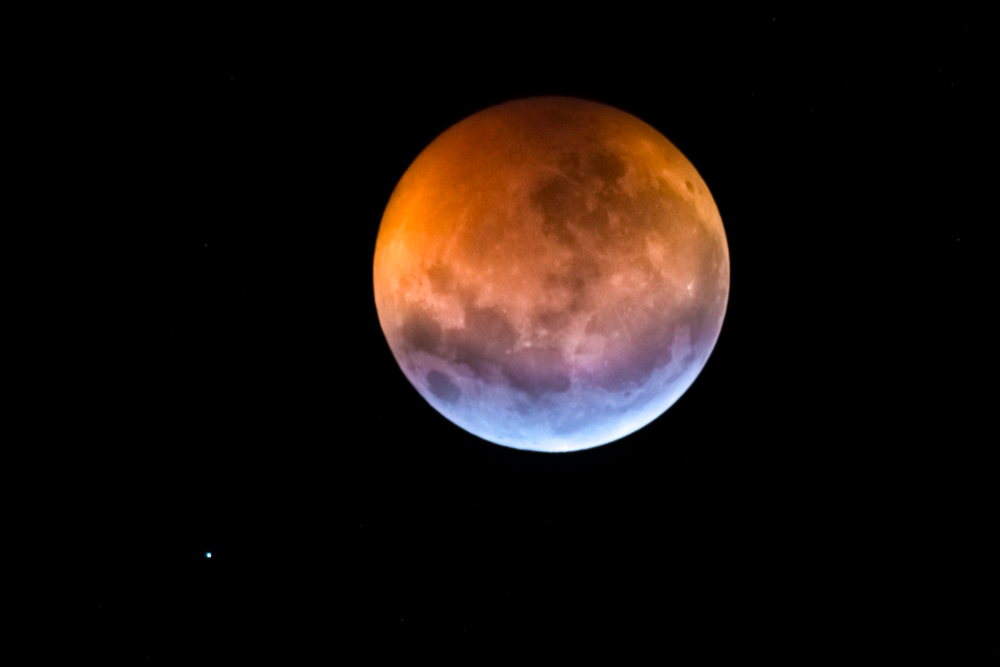
On 7th September 2025, we will witness a total lunar eclipse. Unlike a partial eclipse, here the entire Moon passes beneath the Earth’s umbral shadow. When this happens, the Moon doesn’t disappear, instead, it glows with deep crimson, also known as the Blood Moon.
Why red? Because as the Earth blocks direct sunlight, the Sun’s rays bend through our atmosphere. Blue light scatters, while red and orange hues reach the Moon, giving it a fiery appearance. Mystically, this is seen as a time of endings, karmic revelations, and hidden emotions surfacing.
In Vedic astrology, the Moon represents our emotions, and subconscious. During an eclipse, the Moon comes under the shadow of Ketu (the karmic South Node). Ketu has no head — it doesn’t analyse, it dissolves. Which is why eclipses often feel like an unravelling, pulling up what lies buried within us.
Where will it be visible?
The eclipse will be visible across Asia, Eastern Africa, Australia, and most of Europe.
It will not be visible from most of North America and South America.
In India, it can be seen from New Delhi, Mumbai, Kolkata, Chennai, Bengaluru, Hyderabad, Ahmedabad, Jaipur, and Lucknow.
Other major cities include Singapore, Sydney, Melbourne, Dubai, London, Tokyo, and Cape Town.
Timings (according to Panchang)
- Sutak begins: 12:19 p.m. (IST), 7th September
- Eclipse begins: 9:58 p.m. (IST), 7th September
- Eclipse ends: 1:26 a.m. (IST), 8th September
- Sutak ends: 1:26 a.m. (IST), 8th September
What is Sutak?
In Vedic tradition, the period before and during an eclipse is known as Sutak. This time is considered energetically heavy, so activities like cooking, eating, or performing auspicious rituals are avoided. Instead, Sutak is meant for silence, prayer, meditation, and reflection.
Before the Eclipse
- Keep Tulsi leaves in your fridge and cupboards where food is stored , Tulsi is considered a natural purifier and protector.
- Finish meals beforehand so no food is left to consume during or after Sutak.
- Special note for expecting mothers: Pregnant women are believed to be highly sensitive to cosmic energies. It’s recommended that they remain indoors, avoid sharp objects, rest in stillness, and engage in prayer or chanting during this period.
What can you do during the eclipse?
- Avoid draining conversations or activities that stir unnecessary emotions.
- Engage in chanting, prayer, or meditation — even a few minutes can help.
- Keep your thoughts positive. The Moon mirrors the mind, and what you hold inside during an eclipse can ripple outward.
- If you watch movies or scroll on social media during this time, choose content that is uplifting, happy, and light-hearted. Remember, not all of us are yogis who can meditate for hours, but we can still choose what nourishes our energy.
Chant a Mahamantra of your choice, even softly or in your heart.
Keep crystals beside you to absorb and stabilize energies.
Wear light-coloured clothes, as they reflect rather than absorb heavy vibrations.
Sit in stillness or meditate, if possible, even for short intervals.
Don’ts during the Eclipse
Avoid cooking or eating during Sutak and eclipse hours.
Don’t use sharp objects (scissors, knives, needles, etc.).
Refrain from stepping out or watching the eclipse directly.
Avoid unnecessary movement — stillness keeps your energy safe.
Do not keep leftover food prepared before the eclipse; consume it beforehand or discard it after.
After the eclipse
Take a ritual bath. Traditionally, it’s recommended to add a few drops of Ganga Jal to the water before bathing, symbolizing purification and renewal.
Cleanse your space. Wash utensils, sprinkle water in your home, or light incense/dhoop to refresh the energy.
Donate or feed someone. Acts of charity right after eclipses are considered powerful for dissolving karmic heaviness.
Sit in gratitude. Even a few minutes of quiet reflection, thanking the universe for protection and guidance, aligns you with positive energy going forward.
You may or may not believe in the power of eclipses. And that’s okay. But for me, that night in 2018 showed me that celestial events are not just about the sky, they move something within us too.
We often think that only what we see and touch, our immediate physical reality, affects us. But the truth is, we are deeply connected to the universe. The Sun, the Moon, the stars, the planets, they are not just distant bodies in space. They are energies, and their movements ripple into our lives in ways science is only beginning to understand.
So whether you choose to chant, meditate, or simply sit quietly, see this eclipse as an invitation. An invitation to slow down, turn inward, and release what no longer serves you. Because sometimes, the Moon doesn’t just reflect the Sun’s light, it reflects our hidden selves to us.